Automatic Translation

Tuesday, September 14, 2021

Le Ragazze in Gamba

I'm walking on the Via Francigena del Sud not only as a part of the Road to Rome 2021 - Start Again project, but also as a member and representative of  the Ragazze in Gamba

Brief Italian lesson needed here, seeing as this is an English-language blog: "in gamba" is an idiomatic expression meaning cool, smart, capable, on the ball... you get the idea. By fortunate coincidence, gamba also means leg, so what better name for a group of smart, cool and capable girls (of all ages) who like to walk? Ragazze in gamba is an open social network published via Facebook through which over 60,000 walking women from all parts of Italy can connect, share their stories and agree to walk together. For walking is about more than just going for a stroll: it's a way of discovering the inner strength we all have, even when we don't realise it. It's a way of establishing a new harmony with yourself, those around you, and your natural and cultural environment. It can be a key to unlocking a whole new world of friendships and mutual support. 

The group focuses on and promotes walking routes in Italy, but its membership includes women from outside of the country, and the group's motto is in English: "Just walk!" 

Oh, and yes, the group is open to men, too!

The Ragazze in Gamba network is run by Rete nazionale donne in cammino, a nation-wide association of women walkers whose mission is to promote female empowerment through walking: walking as a way of bringing about greater awareness of oneself and one's place in the world, of establishing greater inner harmony. 

Women have always walked just as much as men, if not more. At least half of medieval pilgrims were women; well-known female pilgrims of the early centuries of the Christian era included Paula, Melania and Etheria, also known as Egeria, who left us a diary of her travels around the Holy Places between 381 and 386, the Itinerarium Egeriae ("Travels of Egeria"), written in the form of a long letter to her "sisters" back home. 


Not much is known about Etheria herself; it is speculated that she may have come from Galicia or from Gaul, and it is thought that she may have been a nun, due to the reference to "sisters", though this term was also used to refer to fellow Christian women in general. Etheria spent three years in Jerusalem, and visited Mount Sinai, Mount Nebo, and the tomb of Job, travelled to Constantinople, Ephesus and other pilgrimage sites in Turkey. In short, she was a very well-travelled woman, and well-educated, too, leaving us a valuable account of the details of Christian liturgy in Jerusalem, written in fourth-century Latin, on its way to evolving into the "vulgar" Romance languages. 

Schematic map of the trips undertaken by Egeria. Copyright: Creative Commons : https://nicolettadematthaeis.files.wordpress.com/2013/03/viaggio-egeria.jpg.

Following in the long tradition established by Etheria, the Ragazze in Gamba are also keeping a diary of their pilgrimage! The members of the group who are participating in various sections of the Road to Rome expedition along the Via Francigena are recording their experiences in a collective diary, hand-written in a notebook which is passed on from one Ragazza in Gamba to the next as the walkers proceed southwards. When completed, this collective pilgrims' diary will be kept in the collection of the Piccolo Museo del Diario, the Little Museum of Diaries in Pieve Santo Stefano which I had occasion to visit on my Long Walk to Assisi earlier this year. The museum and the diaries it contains are truly fascinating, and I highly recommend a visit to anyone walking the Way of Saint Francis. 

An article published recently in the newspaper La Repubblica presents the Ragazze in Gamba and their collective pilgrims' diary, as well as the diary museum itself. 

On my walk on the Via Francigena del Sud, I will be happy to contribute to this Literary Pilgrim Relay, the Staffetta Letteraria delle Ragazze in Gamba! 

With Jennifer, who wrote the diary entry for the first day south of Rome, and Ilaria, founder of the movement, on the Via Appia Antica

Alessandra writing today's diary entry


Monday, September 13, 2021

Via Francigena del Sud Day 2: Albano Laziale - Velletri

What business have I in the woods, if I am thinking of something out of the woods?

- Henry David Thoreau, Walking, and the wild

Road to from Rome 2021, Day 2:  Albano Laziale - Velletri (21 km) 

The Road to Rome 2021 group, about 25 walkers today, assembled at 8 am in front of the cathedral in Albano Laziale, where we met with the arciprete or head priest who told us a few facts about the cathedral, which dates back to the fourth century AD (though it has been rebuilt many times since due to fire and earthquakes). We then headed uphill through the town, with Gerardo of Il Gruppo dei Dodici, an association concerned with the Via Francigena in Lazio south of Rome, to point out some of the town's key sights to us. 


We passed the Roman amphitheatre and entered the enchanted woods of the Castelli Romani park, where we spent the morning amidst chestnut, hazelnut and oak trees, wild cyclamens, streams and springs emerging out of rocky hollows... In short, a fairy-tale atmosphere. And through it ran the Via Sacra, a paved pathway built by the Romans to link the temple of Diana with the temple of Jupiter. 


We emerged from this enchanted forest on another ancient road, Via Roma, and a magnificent view of another volcanic lake, Lago di Nemi, opened up before us. In the town of Nemi we were offered a snack of fresh fruit and cold water by the city government, whom we were able to thank in person at a meeting with the mayor in the charming square in front of the town hall. 


After a short stretch along the road we were back in the woods, and though not as cool and shady as the path through the park in the morning, this forest offered tasty snacks of juicy blackberries! Unfortunately in some spots the blackberry bushes had grown right over the signposts indicating the Via Francigena, and at one point our group accidentally split in two and went two different ways! 

But we all found each other again and made it through the final stretch along the shoulder of a busy road into the town of Velletri. I, along with fellow Ragazza in Gamba Alessandra, Alfredo from Arona, the only other member of the group planning to walk all the way to Santa Maria di Leuca (apart from the indefatigable Myra Stals, our social media manager, who has walked all the way from Calais), and Nello, a local walker who kept us marching at a lively pace, arrived in town well ahead of the others, and were amused to be welcomed by the authorities as if we were the whole group, or at least the most important part of it! We corrected them on that account and sat down over a beer at a nearby bar to wait for the rest of the gang to arrive! 


We all then proceeded to the town hall, accompanied by local guide Sara who showed us the sights along the way. We were received by the deputy mayor in the council chambers, which are decorated with a  fresco of Velletri 's most illustrious citizen: the Emperor Augustus, who was born here in 63 B.C. 


How many towns can boast of being the birthplace of a man who gave his name to a whole month in the calendar? 

«Velitris antiquitus tacta de caelo parte muri, responsum est eius oppidi civem quandoque rerum potiturum; qua fiducia Veliterni et tunc statim et postea saepius paene ad exitium sui cum populo Romano belligeraverant; sero tandem documentis apparuit ostentum illud Augusti potentiam portendisse.»

"Since that remote time when lightning struck a portion of the walls of Velitrae, it was prophesied that one day a townsman would hold great power; for this reason the inhabitants of Velitrae, confiding in this promise, fought frequently against the Roman people, almost to the point of ruining themselves. Only much later did it appear clear that the prophesy referred to the power of Augustus."

(Gaio Svetonio TranquilloVita divi Augusti, v.II.)

In addition of being the birthplace of Augustus, Velletri is renowned as the home of the Velletri Sarcofagus, a second - century sarcophagus carved with scenes from the life of Hercules which is kept in the civic museum. 

After our whirlwind tour of the town, the group split in two to go to our respective accommodations in two B&B's in the countryside just outside Velletri. Ours is run by a walker, Paola, who is active in maintaining the Via Francigena del Sud around these parts, with her Scottish husband, and it has everything a pilgrim could hope for - even a washing machine! Some of us are staying in the rooms, others in the yurta in the garden. 


Sunday, September 12, 2021

Via Francigena del Sud Day 1: Rome - Castel Gandolfo - Albano Laziale

Road to from Rome 2021, Day 1:  Rome  - Castel Gandolfo - Albano Laziale (25.5 km walked) 

12.09.2021

25. 5 km


Appia longarum... regina viarum

The Appian Way, queen of the long roads

- Publius Papinius Statius 


Day 1 walking with the Road to Rome 2021 group! And what a day! 

But let me back up a bit. I arrived in Rome yesterday afternoon, by train, and walked from the station to my hostel in Trastevere, zig/zagging along the way to see the sights in the amazing light of early evening. 


By this roundabout route I eventually came to my hostel, Spitale della Divina Provvidenza in Trastevere. Though located in one of Rome's most popular areas for wining & dining, the hostel is an oasis of tranquility, enclosed within the walls of a convent complex. 

After a walk around the neighbourhood I dined in the hostel with the other pilgrims. It was a mixed group: some had arrived at the end of their walk and were about to head home, while others were planning to continue on further south - after a day exploring Rome. But I was the only one setting off walking in the morning. 


The Road to Rome group arriving at the Circus Maximus

A word from the president of the European Association of the Vie Francigene before we set off


I met up with today's large group of walkers at the Circus Maximus, where a group of 60 to 70 walkers assembled, many of them representatives of local associations and/or residents of Rome joining in for the day. It being Sunday, we met plenty of hikers, joggers and cyclists enjoying a day out on the Via Appia Antica, the Roman road built in 312 BC and later extended all the way to Brindisi. The whole area is now a park, a popular destination with locals as well as tourists. We walked 17 kilometres (11 Roman miles) along the Via Appia Antica, passing by catacombs, baths and any number of Roman funeral monuments along the way.


A word about the Via Appia Antica

In the year 312 B.C., Roman censor Appius Claudius Crassus Caecus ordered the construction of a new road connecting the capital with the south. Originally built to transport troops and military supplies during the wars against the Samnites, crossing the Pontine marsh, a malarial mosquito-infested swamp that had until then formed an effective barrier between Rome and Capua, the Samnites' capital city. The new road allowed the Romans to move soldiers quickly, and keep them supplied, turning the tide of the war and leading the Roman victory in the Second Samnite War in 304 B.C.

Measuring 4.10 metres wide and almost always dead straight, the Via Appia was built by first levelling the dirt, then laying small stones and mortar over it, followed by a layer of gravel topped with interlocking stones that provided a level road surface which is still perfectly visible and usable, 2333 years later! The two-way street had sidewalks on either side and milestone markers, earning it the epithet regina viarum: queen of the roads. Even today, it contains the longest straight stretch of road in Europe: 62 kilometres. The first five kilometres of the road are now used by cars, but after this it becomes a quiet, pedestrianised street through the Parco Regionale dell'Appia Antica.

Numerous funerary monuments were built along the Via Appia, due to the prohibition of burial within the pomerium defining the boundaries of the city of Rome. Tombs of patrician families, cemeteries of paupers who died destitute and were given a decent burial thanks to the charity of one of the confraternities which, already in those days, took care of the sick and dying, and columbaria housing the remains of particular religious or ethnic minorities (the famous catacombs) follow one upon the other along the Appian Way as it leaves Rome behind.  

In 268 B.C. the Via Appia was extended as far as Benevento, and by 191 B.C. it reached Brindisi on the Adriatic Coast. 


Following the fall of the Roman Empire, the Via Appia was not only abandoned, but used as a quarry from which to obtain blocks of stone for building, conveniently squared-off and ready for use. By the turn of the first millennium the land around the road belonged to the church, which later sold it off to powerful local families. The Counts of Tuscolo made the Tomb of Cecilia Metella their fortress, and Pope Boniface VIII assigned to his own family, the Caetani. The Caetani family's imposition of steep tariffs on anyone using the road further contributed to its abandonment and the construction of a new alternative route, the Via Appia Nuova, began as early as the 16th century, and was completed in 1784. The monuments along the Via Appia Antica, reduced to a secondary suburban road, fell prey to collectors in search of ancient artefacts, until it was first suggested that the area be protected and made into an archaeological park in 1931.    


Cart tracks are visible in the ancient Roman paving-stones

With another Ragazza in Gamba, Jennifer, on the Via Appia Antica. Mote about the Ragazze in Gamba in an upcoming post! 


Jennifer is an archaeologist from London, and she deciphered this Latin inscription for us


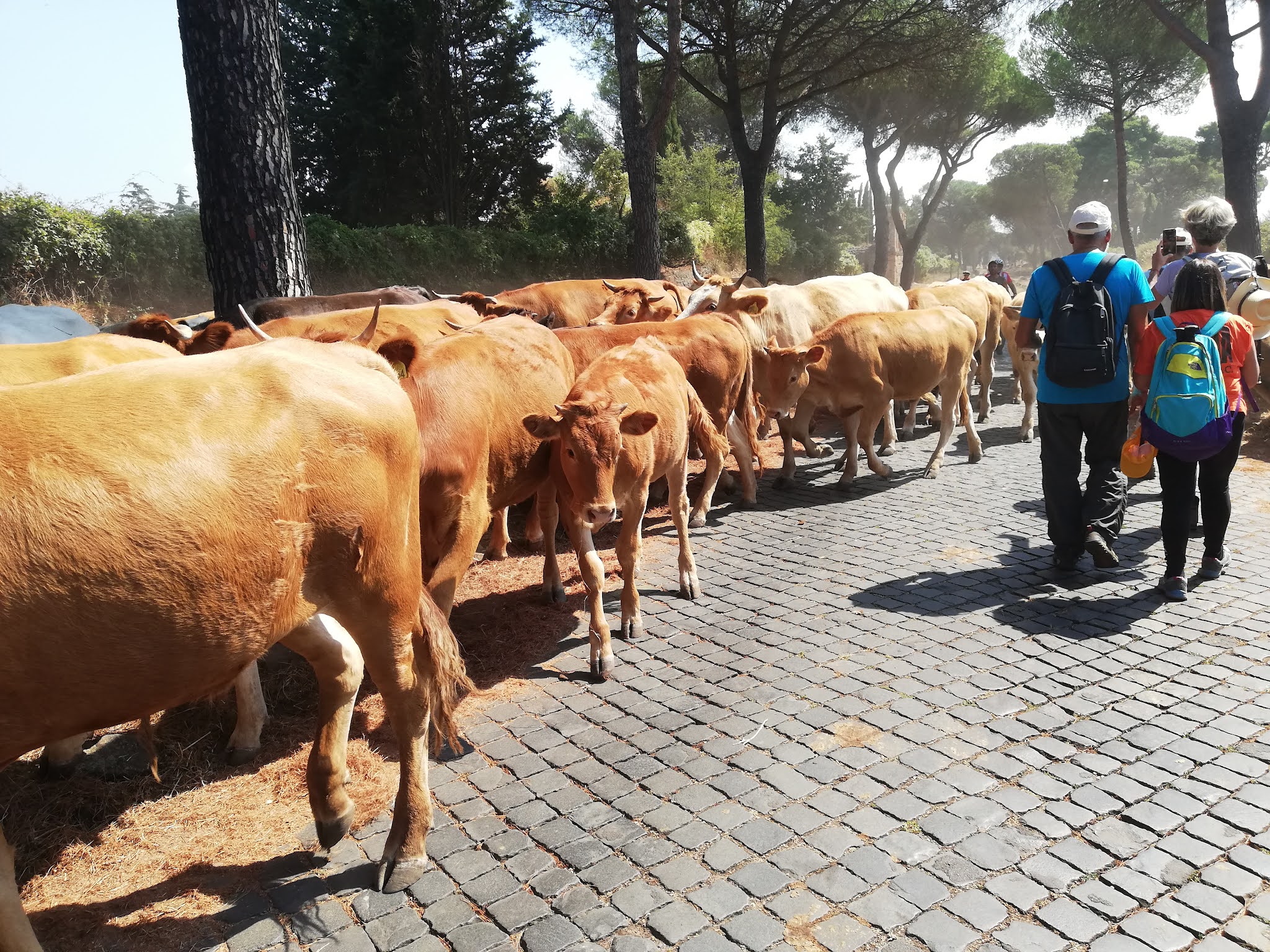
We met a cowherd driving his cattle up the Via Appia. There were quite a lot of cows, but they politely moved aside to make way for us! 


When we came to the end of the 17 km stretch of the Via Appia Antica included in the archaeological park, the Roman paving-stones and the 19th century cobblestones that covered them in some stretches abruptly gave way to a 20th century highway. Here we clambered aboard a bus to drive a few kilometres uphill on a busy road that would not have been nice to walk on, to Castel Gandolfo, where we met with the mayor to admire the view over Lake Albano from the rooftop patio of the Town Hall. 


The Town Hall is right next door to the Pope's summer residence. Pope Francis has not been using it, but the mayor reported that when Pope Benedict was in residence, she could hear him playing the piano from her office! 


Castel Gandolfo's other claim to fame: the world's first letterbox! The pope needs to read his mail even when on holiday 

The Apostolic Palace of Castel Gandolfo has been the summer residence of the popes since the 16th century. During World War II, Pope Pius XII opened up the grounds of Castel Gandolfo to refugees escaping the fighting taking place around Rome. Beginning in January 1944, 12,000 people, including many Roman Jews and other non-Catholics, took refuge on the property, often bringing with them their cows, horses, mules and sheep. During the time they lived there, 36 children were born, almost all of whom were named after the Pope who gave them safe harbour; the pope's private apartment was turned into a nursery (according to Wikipedia). 

But the location on the hills overlooking Lake Albano was the summer residence of prominent world leaders long before the days of the popes: Emperor Domitian built himself an enormous summer palace, the Albanum Domitiani, on the site. It is now part of the Pope's private garden, which is Vatican State territory. This means the town of Castel Gandolfo, and the neighbouring town of Albano Laziale, are in Italy but both border on the Vatican State. 

We walked downhill from Castel Gandolfo to Albano Laziale, believed to be Alba Longa, rival of ancient Rome in its early days as a kingdom, before the city of Rome became an Imperial power. According to one of the founding legends of Rome, the war between the two cities dragged on with no clear winner emerging, and so it was decided that the conflict would be settled by a battle to the death between three warriors from each city. Two sets of triplets, the Horatius brothers of Rome and the Curiatius brothers of Alba Longa, were appointed to fight the decisive battle. Two of the Horatius brothers were killed right away, and the remaining brother, Publius, realising he didn't stand a chance against the three Curiatii, began to run back and forth, so that the three separated to run after him in different directions; he was then able to attack and defeat them one by one, winning the battle for Rome.

The Oath of the Horatii (Jacques-Louis David, 1784)

The mausoleum known as the Tomb of the Horatii and the Curiatii is, however, actually of much later origin, dating from the first century B.C.

Albano Laziale, unjustly neglected by tourism due to being overshadowed by nearby Rome, actually has some very impressive ancient Roman sites of its own. After arriving at our hotel and taking a quick shower, those of us from the group who still had the energy met with the mayor at the civic museum, located in a beautiful villa built in 1831, and then went to see a couple of the town's top sights with a local guide. She took us to the Cisternone, an underground cistern the size of a large cathedral, built at the end of the second century of the Christian era to supply the Roman legionaries quartered in the camp that was built on the site of the town after Alba Longa lost the war to Rome. It's quite dark inside and so the photograph doesn't do it justice! 


From here we went on to the church of Santa Maria della Rotonda, which was originally a Roman nymphaeum, then a Roman bath serving the officers in the Roman legion quartered here. 


If you add to all those kilometres walked and all those amazing sights to see, all kinds of new people to meet and talk to and all sorts of matters to discuss along the way... You will get an idea of what a busy day it has been! I have not even addressed many of the topics I intended to cover in this blog but will save them for future posts. 

I hope not every day on the Via Francigena del Sud will be this intense, or I will never be able to keep up with reporting on it!! 😁


Thursday, September 9, 2021

More about the Via Francigena del Sud

This Sunday I join the "Road to Rome 2021" to start walking from Rome toward Santa Maria di Leuca, at the southern tip of Italy!!! 

The Via Francigena has always been "the road to Rome" from northern Europe - from the Frankish realms, hence the name "Francigena". So what does the road south of Rome have to do with it?  

First of all, people who live in Italy south of Rome might want to head northwards along this route on a pilgrimage to Rome. And secondly, the modern Via Francigena del Sud retraces the steps pilgrims would have taken on their way to the Holy Land in Palestine: the first and most important site of Christian pilgrimage. The present walking route has in fact been reconstructed on the basis of the report of an anonymous pilgrim on his or her way from the Holy Land back home to Bordeaux in the year 333 AD, known as the Itinerarium Burdigalense. Our earliest surviving account of a Christian pilgrimage, this document was written only 21 years after the Emperor Constantine made Christianity legal in the Roman Empire! 

Far from keeping what we would now call a diary, the writer of the Itinerarium Burdigalense merely listed the places where the group stopped overnight or to change their horses (see previous post). This unknown pilgrim travelled from Bordeaux to the Holy Land via the overland route through Constantinople, but travelled partly by boat on the way back, landing in Otranto (Puglia) and then walking/riding north to Rome, on to Milan, and then to France, making the trip into a circle tour.

The Itinerarium Burdigalense, AD 333  


The pilgrimage to the Holy Land could in fact be accomplished travelling either overland or by sea. The overland route became particularly popular during the eleventh century, when the conversion of Hungary to Christianity and the revival of Byzantium had brought most of the route under Christian control. Even so, the pilgrimage to Jerusalem was the most dangerous voyage a pilgrim could undertake. On a five thousand kilometre walk among suspicious and even hostile peoples whose language he or she did not understand, the medieval pilgrim might be attacked and robbed, mistaken for a spy, even sold into slavery. Bishop Gunther of Bamberg reported in 1064, "Truly we have been through fire and water... we have been harassed by the Hungarians, attacked by the Bulgars, and driven to flight by the Turks; we have endured the insults of the arrogant Greeks of Constantinople and the rabid fury of the Cilicians. But we are afraid that even worse disasters lie ahead of us!" (Annales Altahenses Maiores, pp. 66-70; quoted by Jonathan Sumption in The Age of Pilgrimage: The Medieval Journey to God, my chief source of information for today's blog entry [the book, not God!]).      

By the end of the eleventh century, instability in eastern Europe had made the overland route even more dangerous to travel, and pilgrims tended to prefer travelling by sea. But a sea voyage in the Middle Ages was by no means a luxury cruise! Poor pilgrims were stowed away in the most uncomfortable parts of small, unstable boats, sometimes with so little personal space they could not even turn over in their sleep; they had to remain lying down for much of the day, too, to keep out of the way of the sailors and the rigging. They were trampled over by insects, mice, rats, and sometimes larger animals as well, if the livestock brought onto the ship as part of the food supply broke loose! In spite of the presence of this meat on the hoof, the pilgrims who paid the cheapest fares would have been given only bread and water to eat, unless they brought their own food with them. 

Wealthier pilgrims fared slightly better, travelling on the larger oared galleys made available by the Republic of Venice. The medieval Venetians offered an all-inclusive package that included passage and food while onboard the ship and in the Holy Land, the cost of donkeys and pack-horses, tolls, taxes and bribes for Arab officials, guided tours of Jerusalem, and special expeditions including baptism in the Jordan River. The world's first package tour!

Medieval cruise brochure?
Ship of pilgrims – from British Library MS Royal 15 E I f. 404v

But for rich and poor alike, there was absolutely nothing to do on a sea voyage that took six weeks or more! The only forms of entertainment available onboard were drinking, playing cards and singing; more devout pilgrims could spend long hours reading and praying, or, if they were so fortunate (?) as to have a preacher onboard, listening to sermons. The expedition of 1494 was lucky enough to have aboard one Francesco Tivulzio, "a holy friar with a wonderful library in his head", who rose and delivered an elaborate sermon several hours long whenever the ship was becalmed. On the eve of the feast day of St. John, he preached from 5 pm until sunset, promising to deliver the remainder of his sermon the following day! With such options for entertainment, however, "most people simply sat about looking on blankly, passing their eyes from one group to another, and thence to the open sea." 

On the whole, I'd rather walk. Which is why I'll be joining the European Association of the Vie Francigene for "The Road to Rome 2021 - Start Again", a Long Walk open to everyone to join for a day, a week, or a month, celebrating the 20th anniversary of the Association's foundation and relaunching sustainable tourism and slow travel. This group of walkers, the membership of which is constantly changing, has been on the Via Francigena since June 16th, following this great cultural route connecting the north with the south of Europe: from Canterbury, across the Channel, along the entire length of France from north to south, through Switzerland, over the Alps and through northern and central Italy. Tomorrow, September 10, they will arrive in Rome, where they will spend a couple of days resting, meeting with local authorities, celebrating their arrival in the city of St. Peter. I will join them there on September 12 and walk out of Rome on the Appian Way towards the southernmost tip of the Italian peninsula, Santa Maria di Leuca: Italy's own finis terrae!

I hope you will follow me along the way, in this blog, or on my Joanne's Long Walk Facebook or Instagram channel! 


Monday, September 6, 2021

One week to departure!


In less than one week I join the "Road to Rome 2021"!!! 

But, seeing as I like to go against the trend, I will join the "Road to Rome" project in Rome and start walking away from Rome - on the Via Francigena del Sud, towards Santa Maria di Leuca, at the southern tip of the heel of Italy!


The European Association of the Vie Francigene has organised "The Road to Rome 2021 - Start Again" to celebrate the 20th anniversary of its foundation while relaunching a sustainable form of tourism with an emphasis on nature, walking and cycling, and slow discovery of local communities with their local heritage, traditions and gastronomy. A group of walkers, the membership of which is constantly changing, has been on the road since June 16th to bring this message all the way along this great cultural route connecting the north with the south of Europe: from Canterbury, across the Channel, along the entire length of France from north to south, through Switzerland, over the Alps and through northern and central Italy. They are due to arrive in Rome on September 10, where they will spend a couple of days resting and celebrating their arrival in the city of St. Peter. I will join them there on September 12 and walk out of Rome on the Appian Way towards the south of Italy!


A word on the origins of the Via Francigena & the Via Francigena del Sud 

The Via Francigena is a walking route from Canterbury to Rome and on to Santa Maria Leuca, on the southernmost tip of the heel of Italy. The route was already used in medieval times to travel between northern Europe and Rome, not only by pilgrims to the tomb of Saint Peter but by merchants and other travelers too. The first use of the name "Via Francigena" is recorded in the 8th century, but it is actually more accurate to speak of "Vie Francigene" in the plural, as there were many different routes - as they say, all roads lead to Rome! The itinerary of the modern Via Francigena is based on the route taken by Sigeric, Archbishop of Canterbury, who kept a record of the 80 places where he stopped overnight on his way back to Canterbury from Rome in the year 990.  


The manuscript of the Itinerarium Sigerici


The route of the Via Francigena del Sud has even older roots, for it has been reconstructed on the basis of the Itinerarium Burdigalense: a record of the journey of an anonymous pilgrim of Bordeaux on the way back from the Holy Land in the year 333 AD. Written only 21 years after the Emperor Constantine legalised Christianity in the Roman Empire, it is the earliest account we have of a Christian pilgrimage. This pioneering pilgrim did not leave us a detailed account of his (or her?) trip, just a list of the localities where the party stopped to rest or to change horses.     

The first page of the manuscript of the Itinerarium Burdigalense


Here is the list of overnight halts, recorded as the pilgrim proceeds back up the peninsula from Otranto in Puglia to Rome: 

    Crossing the sea, a thousand stadia, which makes a hundred miles, you come to Hydrontum (Hydruntum, Otranto), and halt a mile farther.

    Change at the twelfth milestone Halt at Clipeae (Lupiae, Lecce) - miles xiii.
    Change at Valentia (Baletium, Baleso) - miles xiii.
    City of Brindisium (Brundisium, Brindisi) - miles xi.
    Halt at Spilenees (Speluncae) - miles xiv.
    Change at the tenth milestone (Pto. Villa Nova) - miles xi.
    City of Leonatia (Gnatia, Egnatia, Agnazzo) - miles x.
    Change at Turres Aurilianae (San Vito) - miles xv.
    Change at Turres Julianae - miles ix.
    City of Beroes (Barium, Bari) - miles xi.
    Change at Butontones (Butuntum, Bitonto) - miles xi.
    City of Rubi (Ruvo) - miles xi.
    Change at the fifteenth milestone - miles xv.
    City of Canusium (Canosa) - miles xv.
    Change at the eleventh milestone - miles xi.
    City of Serdonis (Herdonea, Ordona) - miles xv.
    City of Aecae (Troja) - miles xviii.
    Change at Aquilo - miles x.

    Frontier of Apulia and Campania.

    Halt at Equus Magnus (Equus Tuticus, S. Eleuterio) - miles viii.
    Change at the village of Fornum Novum (Forum Novum, Buonalbergo) - miles xii.
    City of Beneventum (Benevento) - miles x.
    City and halt at Claudii (Caudium, Casta Cauda) - miles xii.
    Change at Novae - miles ix.
    City of Capua (Capua) - miles xii.

    Total from Aulon (Valona) to Capua 289 miles, 25 changes, 13 halts.

    Change at the eighth milestone - miles viii.
    Change at Pons Campanus (over the Savone River) - miles ix.
    City of Sonuessa (Sinuessa, Mondragone) - miles ix.
    City of Menturnae (Minturnae, on the Liris) - miles ix.
    City of Formi (Mola di Gaeta) - miles ix.
    City of Fundi (Fondi) - miles xii.
    City of Tarracina (Terracina) - miles xiii.
    Change at Mediae (Posta di Mesa) - miles x.
    Change at Forum Appi (Foro Appio) - miles ix.
    Change at Sponsae - miles vii.
    City of Aricia (Ariccia) and Albona (Albanum, Albano) - miles xvi
    Change at the ninth milestone - miles vii.
    To the city of Rome - miles ix.

    Total from Capua to the city of Rome 136 miles, 14 changes, 9 halts.

    Total from Heraclea (Eregli) through Aulon (Valona) to the city of Rome 1,113 miles, 117 changes, 46 halts.

Source: https://web.archive.org/web/20080511162235/http://www.christusrex.org/www1/ofm/pilgr/bord/10Bord10Valona.html

Note: 1 Roman Mile = 1450 metres

Thursday, August 12, 2021

One month to go!


Only one more month to go!

On September 12, 2021, exactly one month from today, I will join the #RoadtoRome2021 team in Rome and start walking southwards along the #ViaFrancigenadelSud from Rome towards Santa Maria di Leuca, at the very end of the heel of Italy!

Time to start planning.... and training! As soon as our current heatwave is over (it's supposed to reach 40°C here today!) I will start hiking longer and longer distances to get my body accustomed to walking again. 

In the meantime, I am researching some fun anecdotes and trivia to publish on the pages of this blog along the way. Expect to encounter ancient Romans, mythological beasts and mysterious palindromes along the Road (to) from Rome in September/October!