Automatic Translation

Sunday, April 16, 2023

Road to Home 2023 Day 1: Calais - Wissant

 “Ce n’est que le premier pas qui coûte.”

"It's only the first step that counts"

- French proverb

Calais - Wissant 21 km

Not sure how true this proverb is... and Hilaire Belloc, who quotes it in The Path to Rome, his account of his 1902 journey to Rome on foot, strongly disagrees. But a lot of effort certainly goes into taking that first step - months of training, weeks of planning, a day or so of travel to the selected departure point.

I took my first step on the Via Francigena as soon as I stepped out the door of the hostel in Calais, located just behind the first row of prime waterfront buildings. As is often the case on the night before beginning a daunting undertaking, I had not slept a lot. It was Saturday night in Calais, as elsewhere, and the auberge de jeunesse, a rather institutional place, was hosting groups of teenagers on some weekend programme as well as several football teams consisting of very small boys. I'm not sure which it was that decided to take the opportunity for a pyjama party, but their rooms must have been directly under mine, and by the time they called it a night, it was nearing the hour in which I habitually wake up! This background noise combined with the agitation of beginning a new voyage and too much chocolate before bed (packed some leftover Easter eggs, ostensibly for snacks along the trail...) meant that I did not get as much as sleep as the level of comfort of the bed in my simple private room deserved!


Making crêpes for football teams at breakfast in Calais


As you can see in the screenshot below,  the first stage of the Via Francigena in France does not proceed directly southward in the direction of Rome, but takes you on a side trip to Wissant,  20 km further west along the coast from Calais. Then you spend the next day walking southeast, ending up near Guînes, which would have been only half a day's walk from Calais had you gone directly!


Why the wiggle?

So why does the Via Francigena meander along the coast to Wissant instead of heading directly south to Guînes? Because Archbishop Sigeric the Serious, whose journey the modern Via Francigena reconstructs, did not take a car ferry to Calais but sailed to Wissant, which was the major port in his day, back in the year 990. The port has sanded up over the course of the last thousand years, and pilgrims coming from the start of the Via Francigena in Canterbury now take the ferry to Calais, but the Via Francigena travels from Calais along the seaside to Wissant in order to join Sigeric's historic route. 

Besides, it's an amazingly beautiful walk!


Within 15 minutes of beginning the very first day of my walk, I met four other Canadians! One of them lives near where I grew up, on Vancouver Island, and another is originally British, from Manchester, where I have aunts and uncles and cousins! 😄 

Proving the veracity of two other common proverbs: 

1. The cammino provides; and

2. The world is a small place!


Together we walked along the beach to Sangatte, climbed the hill to Noir-Mottes and then to the monument atop Cap Blanc-Nez, where we stopped for lunch. Below us were white cliffs just like those across the Channel in Dover, and the gravel on the path was composed of flintstones, which, I learned in Kent last year, always come with chalk. As the morning mists cleared we could see the White Cliffs of Dover across the Channel,  though not clearly enough to photograph them.


Following one of the most scenic lunch breaks on the Via Francigena, we descended to walk along the top of the cliffs in the photo below, then down to the beach for the rest of the way into Wissant. 


Wissant

The name Wissant comes from the Dutch Witzand, "white sand" (duh!). This village of a thousand souls located at the eastern end of a lagoon has been a fishing village since medieval times, when it was also a major port of embarkation to Britain; it was from here that Thomas Becket set sail on the first day of December 1170, headed for Canterbury and martyrdom. 


The shifting coastal sands silted up the harbour around the end of the 12th century, around the time that the harbour of Calais was rising in importance. Around the end of the 19th century people began to build villas on the sand dunes, and in the early 20th century an entrepreneur from Calais dug up sand and gravel from the dunes in order to fill in the bed of the former lagoon to the west of Wissant. The area excavated is now a nature reserve, with lakes that have formed in the hollows left behind by the excavations.

Upon arriving in this fine seaside town I repaired to my accommodations, washed myself and my clothes, and spent the rest of the afternoon basking in the sun along with my rapidly drying laundry. The afternoon sunshine floods directly in through the window of my small but comfortable room, only a hundred metres from where my new friends, Henry, Haidee, Marjorie and Laurie, are staying. I can in fact hear them chatting over a beer at their hotel bar as I write this! We parted with a promise to meet again for dinner at seven.

Laundry should be dry by then!


Today's accommodations: Hôtel de la Plage, Wissant


Saturday, April 15, 2023

Road to Home 2023: Calais

You’re off to Great Places! Today is your day! Your mountain is waiting, so… get on your way

Dr. Seuss, Oh, the places you’ll go


Today is the day... to get on your way... on a train to Calais!!!

It took a day and a half to get from my hometown in Italy to Calais, in order to begin the French part of the Via Francigena. First, a train to Turin, where I stayed overnight with a Canadian friend I met on the Camino de Santiago four years ago. Catching up with Alyssen, who has since moved to Italy, over drinks in a garden surrounded by tulips was the perfect way to begin a new Long Walk adventure!

Up before dawn, I walked across the sleeping city to the station to catch the 7:11 high-speed train from Turin to Paris. Only six hours, and so much more relaxing than flying! My only complaint about the train is that it's painted with pretty pictures on the outside, so that you can't see out very well through the windows: it's like looking through mesh - very fatiguing on the eyes! It's too bad, because the landscape coming through the Alps would have been stunning. But apparently train designers think that passengers nowadays would rather look at their phones than at the landscape, so they provide a wi-fi connection, but not windows that you can actually see through.


I had two and a half hours to make my connection in Paris, and it only takes an hour to walk from the Gare du Lyon to the Gare du Nord. Who needs the métro? I even had time to wander arund an antiques market, and to peer through the windows of shopfronts at hordes of African hairdressers busy making braids.

Two hours in Paris?
Who wants to spend them underground??


Street market


Dunno what this is, but it looks impressive!


The Gare du Nord

Then another high-speed train whisked me off to Calais, the start of the Via Francigena in France and the continuation of the trail I followed last year from Leeds, Yorkshire  - my birthplace - to Dover, just 34 km away across the Channel. 

34 kilometres - that's only a day's walk - if you're Jesus, and can walk on water! If you're not, you have to take the ferry, which is what most Via Francigena walkers do. 

Ferry departing Calais

Calais is the town in France closest to England, and in fact Calais has been an important centre for transport and trade with England since the Middle Ages. For this reason it has always been disputed between the two powers: during the Hundred Years War, Edward III of England laid siege to Calais in 1346. Angered by the city's "obstinate defence", King Edward ordered that the entire population of the city be put to the sword. 


The Burghers of Calais

Contemporary chronicler Jean Froissart tells the story of what happened next: Edward offered to spare the people of the city if six of its leaders would surrender themselves to him, presumably to be executed. Edward demanded that they walk out of the city gate bareheaded and barefoot, carrying the keys to the city and castle and wearing nooses around their necks, offering themselves to be hanged. One of the wealthiest of the town leaders, Eustache de Saint Pierre, volunteered first, and five other burghers joined him as Saint Pierre led this envoy of volunteers to the city gates. 

Auguste Rodin captured this moment, and the Burghers' poignant mix of defeat, heroic self-sacrifice, and willingness to face imminent death, in his famous sculpture Les Bourgeois de Calais, scaled somewhat larger than life, erected in the city in 1895.


Rodin's design was controversial because it lacked "overtly heroic antique references" and the positive image of glory considered essential in public sculpture at the time; it contained no allegorical figures, it was not in the usual pyramidal arrangement, and it was designed to be placed not on a pedestal, but at ground level. Rodin wanted the townspeople to "almost bump into the figures" so that they would feel solidarity with them, experiencing their "pain, anguish and fatalism", which the sculptor saw as the true heroism of self-sacrifice.  


According to Froissart's story, the burghers expected to be executed, but their lives were spared by the intervention of England's queen, Philippa of Hainault, who persuaded her husband to be merciful by claiming that their deaths would be a bad omen for the unborn child she was carrying. 

(Source: https://en.wikipedia.org/wiki/The_Burghers_of_Calais)


Another cast of the Burghers of Calais, in the New York Metropolitan Museum of Art

Calais under British rule

A treaty in 1360 formally assigned Calais to English rule. Under the British, the city grew into a thriving centre of wool production, known as the "brightest jewel in the English crown" owing to its great importance as the gateway for the tin, lead, lace and wool trades. 

Calais remained under English control for two hundred years, until it was recaptured by France in 1558. It was under English rule that the cathedral of Notre-Dame was built: the only church in France built in what is known as the English perpendicular style: a style of late-Medieval Gothic architecture typically featuring large windows with perpendicular vertical and horizontal tracery and pointed four-centred arches. 


Unfortunately the cathedral was closed by the time I got there, and so I was unable to see the inside of one of the few surviving historic buildings in Calais, which was largely destroyed (again) in the Second World War. 


World War II destruction

Calais was virtually razed to the ground during World War II: in May 1940, it was a strategic bombing target of the invading German forces who took it during the siege of Calais. The Germans built massive bunkers along the coast in preparation for launching missiles at England. In May 1940 the city was under siege again for several days, and much of it was flattened by artillery and dive-bombing before falling to the Germans, who made it their command post for the region and fortified the town heavily as they believed the Allies would invade there. Calais was very heavily bombed and shelled in a successful effort to disrupt German communications and persuade them that the Allies would target the area, but the Allied invasion on D-Day actually took place much further west, in Normandy.

The modern Place d'Armes, with a sculpture of General De Gaulle and his wife

An admirable example of the type of post-war architecture beautifying the Calais waterfront 

Stylish fast-food kiosks on the waterfront

The burgers of Calais come with plenty of fries!


The Calais Jungle 

The city of Calais saw an invasion of another kind around the turn of the millennium, when migrants and asylum seekers from various troubled parts of the world began to set up makeshift camps in which to bide their time while awaiting an opportunity to stow away on a vehicle travelling across the Channel to England. 

For about fifteen years the shantytown thrived on a former landfill siteKnown as the Calais Jungle, the temporary settlement was home to thousands of people, and had its own shops, restaurants, hairdressers, schools, places of worship and even a boxing club, in addition to the makeshift residences. Its existence exacerbated tensions between Britain and France, until French authorities staged an invasion of their own, clearing the camp in October 2016. 

Many of the migrants eluded attempts to resettle them elsewhere in France, refusing to give up their hopes of crossing the Channel, hiding out on the outskirts of Calais to wait for their big chance. The "Calais migrant crisis" continues to be a source of strife between Britain and France today.      


If you look closely you will see a migrant's sleeping bag in this picture, taken outside the train station 

      Ni tenir vil l’estrang que ven d’autrui pays,
Car en aquest mont nos sen tuit pellegrin.
 
(Nor despise the stranger which cometh from far.
For in this world we are all pilgrims.)

-          La Nobla Leyçzon – The Noble Lesson, 12th-century Waldesian text


Today's accommodations: Centre Européen de Séjour


This day of preparation for walking the Via Francigena in France ended in the best possible way, with a webinar by the author of my brand-new guidebook, the Reverend Sandy Brown, about - walking the Via Francigena in France!

Thank you Sandy for all the helpful advice! I am looking forward to starting to put it in practice tomorrow morning!!


Thursday, February 16, 2023

Coming up next: Road to Home 2023!

Road to Home, a Long Walk from my birthplace in Leeds, England, to my current home in Italy, is set to continue next week!

Last May/June, I walked from my birthplace in Leeds to the start of the Via Francigena in Canterbury and then on to Dover, following the route of St. Bernard's Way, plotted out by Tony Maskill-Rogan of Abbey Walks in 2014. It took me 30 days to cover a total of 756 kilometres. 


Next, I plan to pick up the Via Francigena in France, starting in Calais. 

Here is an interactive map showing potential stopping places along the route of the Via Francigena, based on the places where the Archbishop of Canterbury Sigeric stopped in 990. You can click on it to view a larger version in Google Maps.


On the third day of Road to Home 2022 in England, I found myself in the village where my grandfather was born, exploring the place where my great-grandfather lived and worked as a coal miner before he was called up to fight in the trenches of the Somme. I found his name on the monument to the fallen outside the village church.

This Spring I will follow in the footsteps of my great-grandfather on his way to the battlefields of the Somme, where he died at the age of 28 on 7 July 1916. Starting on the eleventh day after leaving Calais, I will take a detour from the Via Francigena to walk the 100 km GR® de Pays:Bataille de la Somme, a hiking route among the battlefields and graveyards of the Somme, which will take me to his grave in Thiepval and then back, by a circle route, to the Via Francigena at Peronne.

Stay tuned!

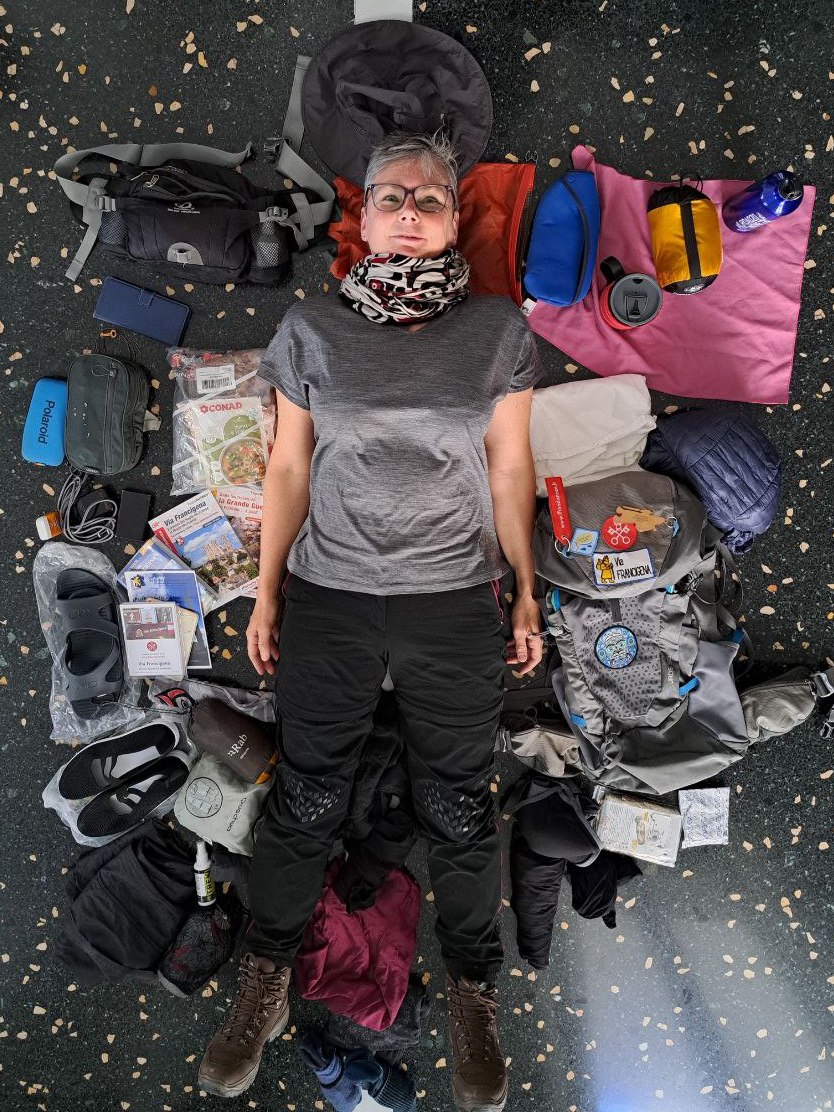
How will all this ever fit into a 38-litre pack??

My packing list for walking in northern France in April is a bit longer than it was last time, for walking in southern Italy!

• 1 spare T-shirt, 3 pairs underwear, 2 pairs socks, leggings, nightgown/dress with nylons & lightweight wool sweater for evening wear, all in a dry sack
• thermal sheet sack, pillowcase, small microfibre travel towel, emergency blanket, in another dry sack
• rainy weather kit: rain jacket, rain hat, waterproof case for phone, plastic rain pants, poncho
• puff jacket
• toiletries bag: travel-sized toothpaste, small toothbrush, small bar of soap in a tin, 10 ml shampoo, medications, band-aids, miniature microfibre travel towel
• shoes for evening wear, in plastic bag
• flip-flops, in plastic bag
• small waterproof bag containing miscellaneous useful items: a small bottle of liquid detergent and a silicone sink plug for washing clothes, camping laundry line, a few small plastic clothespegs, emergency sewing kit, roll of Leukoplast surgical tape for preventing blisters, mosquito and tick repellent, large safety pins for hanging damp laundry on backpack while walking
• Ziploc bag of teabags and instant coffee pouches, instant oatmeal, instant soup mix, single-serving envelopes of olive oil, salt & pepper. Food is not always on hand in France!
• In top & side pockets: sun/rain hat, small sunscreen, waterproof backpack cover, small plastic box for carrying food, fluorescent wristband to wear when walking on roads, water bottle with insulating cover, plastic cup with a container of trail mix inside
• in waist pack: Spork, pocket knife, mini-flashlight, whistle, phone, charger & cable, power bank & cable, guidebooks & information on the trail, pilgrim credential, notebook, wallet, bandana, small water bottle, pandemic supplies: face masks & sanitising gel
• wearing: T-shirt, zip-off pants, hiking boots, scarf, handkerchief, long-sleeved merino wool top


All packed up and ready to go!